Integrating Green Chemistry into the Curriculum with IMPACT
De Verteuil, J.; Jessop, P. G.; Bongers, A. Integrating Simple Environmental Impact-Based Metrics into the Undergraduate Curriculum. J. Chem. Educ.2024, 101 (4), 1592–1598. https://doi.org/10.1021/acs.jchemed.3c01217.
The most important learning objective in green chemistry education is the ability to identify the synthesis, process, or chemical that is least environmentally harmful.
Existing metrics fall short for different reasons. Mass-based metrics fail to assess environmental harm, while life cycle assessment (LCA) is much too complex to insert into the existing curriculum without displacing a significant amount of content.
However, individual environmental impact-based metrics derived from LCA can be easily incorporated into the curriculum with very little instruction time and no significant displacement of content.
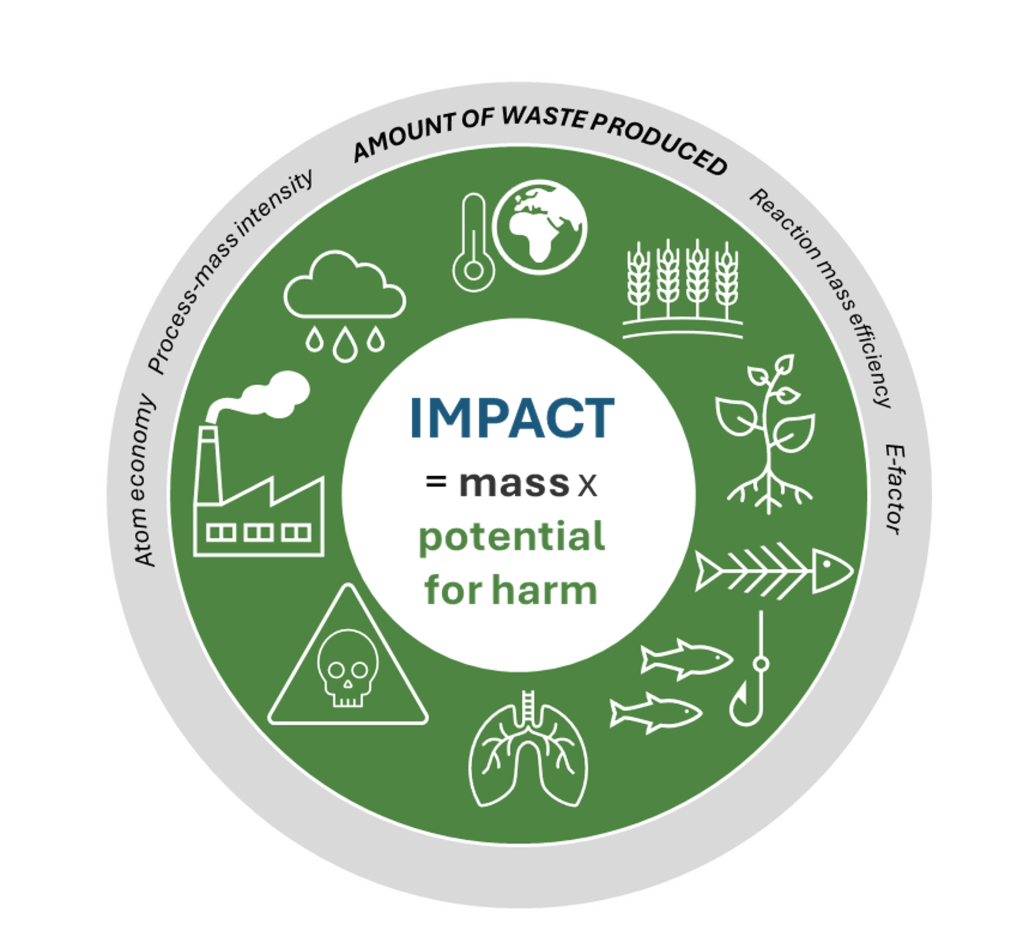
Impact Metrics
For first year or introductory chemistry, we show how typical first-year calculation questions can be expanded to allow students to use an impact-based metric to identify the least harmful of the presented options.
Jigsaw Impact Analysis
For upper-year courses, we propose an activity that scaffolds the LCA process of compiling data, calculating individual impact-based metrics, combining metrics, and using context to make a decision. This activity was implemented using a problem-based learning model to support multivariate reasoning through peer discussions.
Greener Organic
Use this free resource to learn essential concepts in organic chemistry.
In this set of modules, you will explore how organic chemistry can relate to toxicity, sustainability, and renewable resources. Each module is an introductory lesson on an essential topic in organic chemistry, presented through the philosophy and metrics of green chemistry.
 Amanda Bongers